استروماتوليت ها (Stromatolites)
استروماتوليت :
وازه ي استروماتوليت بر گرفته از كلمه ي يوناني استروما به معني پوسته، بستر يا چينه و ليتوس به معني صخره يا سنگ مي باشد كه در گذشته به آن لامينه هاي جلبكي گفته مي شد.

الف) پراكندگي زماني استرو ماتوليت ها:
استروماتوليت ها بروي كره ي زمين در دوره ي پركامبرين فراوان بوده و بهترين ارگانيسم سازنده ي سازنده ي اين دوران مي باشندچنانچه به طور كلي پالئوزوئيك زيرين را دوره ي گسترش تريلوبيت ها بدانيم بايد پروتروزوئيك را دوره ي مربوط به استروماتوليت ها در نظر گرفت . در تصوير زير پراكندگي و گسترش استروماتوليت هاي پركامبرين در سنگهاي پركامبرين در سنگهاي كر بناته قاره هاي مختلف ديده مي شود.

نكته قابل تامل در در نقشه بالا مربوط به كشور ايران مي باشد .در مورداستروماتوليت هاي پركامبرين ايران كه به خوبي در تصویر بالامشخص هست، بايد اين نكته را گفت كه سازندهايي كه حاوي اين ساختارها(استروماتوليت ها) هستند اکثراً داراي سن پر كامبرين بالايي تا كامبرين آغازي بوده كه از آن جمله مي توان به استروماتوليت هاي سازند بايندور (پركامبرين پاياني) و سازند سلطانيه (پركامبرين پاياني تا كامبرين آغازي) بويژه عضو دولوميت با لايي اشاره كرد. حداكثرتكامل استروماتوليت ها در پروتروزوئيك مي باشد و در اواخر پركامبرين اين تكامل نقصان مي پذيرد . يكي از نظراتي كه در مورد رشد وتكامل استرومانوليتها در پروتروزوئيك وارد است ، نبود جانوران حفارو زير زميني و بويژه علفخوران (شكمپايان) براي ناپديد كردن رسوبات مي باشد . چون اين جانوران با بهم زدن رسوبات ، از رشد كف پوشها در نتيجه از رشد استروماتوليت ها جلوگيري مي كنند. اين ساختار ها(استروماتوليت ها)،تنوع و تعدادشان در طول پالئوزوئيك كاهش يافته ودر درياي پيشرفته ي امروز كمياب مي شوند.
ب) پراكندگي مكاني استرو ماتوليت ها:
با توجه به نكاتي كه در بالا بيان شد مي توان به اين نتيجه رسيد كه بهترين مكان ها براي تشكيل استرو ماتوليت ها محيط هايي مي باشند كه موجودات پر سلولي همچون ماهيها و شكمپايان نتوانند پوششهاي جلبكي را بخورند و آنها را از بين ببرند در نتيجه محيط بايد: الف) به شدت شور باشد ب) بيشترين نور خورشيد را دريافت كندج)داراي بيشترين رطوبت باشد د) و داراي انرژي زيادي باشد. به همين دليل هست كه استرو ماتوليتهاي عهد حاضر را در مناطق گرم ،مرطوب و آبهاي شور محيط هايي چون سواحل جنوبي خليج فارس ، باهاماس و شارك بي ملاحظه مي كنيم.
ج)مكانيسم تشكيل استرو ماتوليت ها:
استرو ماتوليت ها از اتصال مواد رسوب به يك بستر جلبكي يا پوششي از سيانو باكتريها(كه قبلاً جلبكهاي سبز آبي گفته مي شد)تشكيل مي شوند .
مكانيسم تشكيل استرو ماتوليت ها بدين صورت مي باشد كه سيانو باكتري ها از آب، دي اكسيد كربن و نور خورشيد جهت تهيه غذا استفاده مي كنند كه محصول دو گانه اين جريان اكسيزن و كربنات كلسيم بوده كه به صورت لايه اي از لعاب اغلب بالاي كف پوشها تشكيل ميدهند كه داراي حالت چسبندگي مي باشد. اين مسئله همراه با حالت رشته اي اين جلبكها باعث به تله افتادن و محصور شدن ذرات رسوبي شده و تكرار اين عمل باعث ايجاد استرو ماتوليت مي شود . در نتيجه اين ساختارها، از زوج هايي از لايه هاي تيره غني از مواد آلي كه به طور متناوب با لايه هاي روشن غني از رسوب قرار دارند تشكيل مي شوند. (با توجه به شكل زير)

د) طبقه بندي استروماتوليت ها:
طبقه بندي استروماتوليتها اغلب بر اساس شكل و مورفولوژي آنها صورت مي گيرد كه اين تغيير در مور فولوژي خود وابسطه به انرژي محيط است به طوري كه اگر انرژي محيط كم باشد لامينه ها به صورت موازي و اگر انرژي زياد باشد اين اشكال به صورت گنبدي واگر انرژي خيلي زياد باشد به صورت گنبد هاي جدا از هم و ستوني ديده مي شوند . بدين ترتيب انواع استروماتوليت ها از نگاه مورفولوژي به 5 دسته تقسيم مي شوند :
1) استروماتوليت هاي مسطح Planar Stromatolites)) :
ساده ترين نوع استروماتوليت ها مي باشند كه به طور تيپيك در پهنه هاي جذر مدي بسته تشكيل مي شوند بنابر اين ممكن است چند ضلعي هاي حاصل از خشك شدگي را نشان دهند و حاوي روزنه هاي لامينه اي (Laminoid Fenestrate) يا حفرات كشيده بوده كه توسط كاني هاي تبخيري پر شده اند .

2) استرو ماتوليت هاي گنبدي(( Domal Stromatolites :
در اين نوع استرو ماتوليت ها لامينه ها از يك گنبد تا گنبد بعدي ادامه مي يابد . اين نوع استرو ماتوليتها در يك طبقه بندي كه توسط آقاي لوگان و همكاران در سال 1964 ارائه شده تحت عنوان نيمكره هاي به طور جانبي متصل به هم( كاسه هاي كنار هم چيده شده)(Hemispheroides (Laterally Linked يا به طور مخفف (LLH ( معرفي شده اند .

3) استرو ماتوليت هاي ستوني ((Columnar Stromatolites:
ساختمان هاي منفردي مي باشند كه ممكن است چندين متر ارتفاع داشته باشند كه نتيجه اجبار رشد عمودي براي نفوذ نور خورشيد به ارگانيسمها ي فتوسنتز كننده به وجود آيند اين نوع استرو ماتوليت ها در تقسيم بندي آقاي لوگان تحت عنوان نيمكره هاي به طور عمودي انباشته(كاسه هاي روي هم قرار گرفته شده) Vertically Staked Hemipheroids)) يا به طور مخفف ((SHمعرفي شده اند .

4) استرو ماتوليت هاي پيچيده ((Complex Stromatolites :
بعضي از استرو ماتوليت ها ممكن است تر كيبي از گنبد ها و ستون ها باشند . بدين حالت استرو ماتوليت هاي پيچيده گفته مي شود در تقسيم بندي لوگان از آن به عنوان (LLH-SH) نام مي برد .

5) استرو ماتوليت هاي كروي( انكوئيد ها)Oncoids) ) :
نوعي ساختمان رسوبي رسوبي مي باشند كه داراي لا ميناسيون داخلي متحد المركز بوده و ممكن است نا متقارن باشد لو گان از آن تحت عنوان ساختمان هاي كُروي (ss)نام مي برد.

س) اهمّيت استرو ماتوليت ها :
استرو ماتوليت ها فسیل نيستند و به ما سن معيني را نمي دهند ولي براي تفسير محيط رسوبي كمك شاياني را مي كنند. اين ساختها معمولاً در محيطهاي ساحلي و نزديك ساحل ايجاد مي شوند .
همچنين در چند سال اخیر استفاده هاي اقتصادی نیز از اين ساخت ها شده به طوری كه بعد از برش و صیقل دادن اين اشکال آنها را به قیمتهای بعضاً گزاف در بازار هاي بين المللي به فروش مي رسانند.
نكات:
نكته1: استروماتوليتها خود نوعي از ريف ها به حساب مي آيند در نتيجه به اين ساختارها ريفهاي استروماتوليتي نيز مي گويند.
نكته2: در حال حاضر استرو ماتوليت ها درمنتقه اينترتايدال بالايي سواحل جنوبي خليج فارس (در اينترتايدال پاييني بدليل وجود موجودات حفار ودر سوپرتايدال بدليل خشكي زياد اين ساختار ها باقي نمي مانند ) ودر سواحل گرم ومرطوب باهاماس در منطقه اينترتايدال و سوپر تايدال تشكيل مي شوند كه در اينترتايدال به دليل وجود موجودات چرنده باقي نمي ماند و فقط در سوپر تايدال اين منطقه ديده مي شوند. همچنين حالات ستوني اين اشكال در ساب تايدال خليج كوسه(Shark Bay) غرب استرا ليا نيزديده مي شود
Stromatolite Fossils
In many respects stromatolites are the most intriguing fossils that are our singular visual portal (except for phylogenetic determination of conserved nucleic acid sequences and molecular fossils) into deep time on earth, the emergence of life, and the eventual evolving of the beautiful life forms from Cambrian to modern time. A small piece of stromatolite encodes biological activity perhaps spanning thousands of years. In broad terms, stromatolites are fossil evidence of the prokaryotic life that remains today, as it has always been, the preponderance of biomass in the biosphere. For those that subscribe to the theory of the living earth, it is the prokaryotes that maintain the homeostasis of the earth, rendering the biosphere habitable for all other life. They maintain and recycle the atomic ingredients upon which proteins that "are" all life are made, including oxygen, nitrogen and carbon. We humans are, in simple terms, bags of water filled with proteins and prokaryotic bacteria (the bacteria in your body outnumber the cells in your body about 10 to 1). We humans have descended from organisms that adapted to living in a prokaryotic world, and we humans retain (conserved in evolutionary terms) in our mitochondria the cellular machinery to power our cells that we inherited (i.e., endosymbiosis) from the prokaryotes of deep time on earth.
Stromatolites and their close cousins the thrombolites, are rock-like buildups of microbial mats that form in limestone- or dolostone-forming environments. Together with oncoids (formerly called "algal biscuits" or "Girvanella"), they typically form by the baffling, trapping, and precipitation of particles by communities of microorganisms such as bacteria and algae. In some cases, they can form inorganically, when seawaters are oversaturated with chemical precipitates. Stromatolites are defined as laminated accretionary structures that have synoptic relief (i.e., they stick up above the seafloor). Stromatolite-building communities include the oldest known fossils, dating back some 3.5 billion years when the environments of Earth were too hostile to support life as we know it today. We can presume that the microbial communities consisted of complex consortia of species with diverse metabolic needs, and that competition for resources and differing motility among them created the intricate structures we observe in these ancient fossils
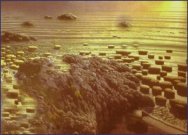
Excluding some exceedingly rare Precambrian fossils such as the Ediacaran fauna, stromatolites are the only fossils encoding the first 7/8th of the history of life on earth. They encode the role that ancient microorganisms played in the evolution of life on earth and in shaping earth's environments. The fossil record of stromatolites is astonishingly extensive, spanning 4 billion years of geological history with the forming organisms possibly having occupied every conceivable environment that ever existed. Today, stromatolites are nearly extinct in marine environments, living a precarious existence in only a few localities worldwide. Modern stromatolites were first discovered in Shark Bay, Australia in 1956, and through out western Australia in both marine and non-marine environments. New stromatolite localities have continued to be discovered in various places such as the Bahamas, the Indian Ocean and Yellowstone National Park, to name but a few localities.
Stromatolites are most often described as biogenically-produced structures formed by colonies of photosynthesizing cyanobacteria. However, this is an enormous oversimplification. Science now knows that all domains of life (the Archaeans, Eubacteria, and Eukaryotes) all appeared in the Archaean Era. Which of the prokaryotes came first, the Archaeans or the Eubacteria remains a mystery, but a consensus is emerging that these primitive microorganisms laterally exchanged genes; if so, the concept of the single common ancestor for all life becomes a bit fuzzy (see Woese, 1998). While formation by colonies of cyanobacteria is probably the primary mechanism for formation of stromatolite in the deep time of the Archaean and half way through the Proterozoic, it is unlikely to have been the only mechanism. Recent research indicates the other prokaryotic and the most genetically diverse domain of life, the Archaeans, evolved alongside and possibly swapped genes with the Eubacteria. All prokaryotes (both Eubacteria and the Archaeans reproduce by cell division (binary or multiple fission) and, lacking sex, are essentially clones and among the slowest evolving organisms. Moreover, molecular fossils indicate that primitive Eukaryotic microorganisms appeared more than 3.5 Ba. Thus, before the end of the Archaean time some 2.5 Ba, all three domains of life (Eubacteria, Archaea, and Eukaryotes) existed and were likely already quite diverse. Some were autotrophs, some chemotrophs and some heterotrophs, and collectively they had a multiplicity of metabolic processes from which to derive their energy. Just as microorganisms were extremely diverse in deep time, so is there a corresponding extreme diversity of biogenic and chemical mechanisms that are plausible for the formation of laminar carbonate and other structures that we call stromatolite. Ascribing all stromatolite formation in the Archaean and Proeterozoic to cyanobacteria, seems an unreasonable assumption.
Other research posits (Bank, C., 2002), based on genome sequencing, that cyanobacteria may have originated as late as 2.3 billion years ago, and were preceded by sulfur-oxidizing bacteria and sulfate-reducing bacteria. This mirrors the changes in the geochemical record, centered around 2.7 billion years ago. The hypothesis is consistent with geology that finds isotopic fractionation of sulfur compounds becomes large, followed by the sudden increase in oxygen in the atmosphere and surface water environments at about 2.2 or 2.3 Ba.
Whether or not stromatolite contains preserved cellular structure remains controversial, though the consensus is that in special cases, remnants of ancient cell structure can be viewed using special polishing techniques and high magnification. Additionally, determination of atom ratios (so called molecular fossils) in Archaean sediment from Australia has led to sound conjecture that microorganisms with nuclei appeared before 3.8 Ba.
Nonetheless, the cyanobacteria are conjectured to have been the predominant form of life on early earth for more than 2 Billion years, and were likely responsible for the creation of earth's atmospheric oxygen, consuming CO2 and releasing O2 through their photosynthetic metabolism. Creation of the modern atmosphere is, of course, perhaps the most critical event in geological history that powered the Cambrian explosion and subsequent evolution of the aerobic forms of life, including all animals. During Precambrian times, bacterial mats formed a platform for trapping and cementation of sediment. For photosynthetic bacteria, depletion of carbon dioxide in the surrounding water could cause precipitation of calcium carbonate that along with grains of sediment were then trapped within the sticky layers of mucilage (that formed a film for UV protection) that surrounding the bacterial colonies. Cyanobacteria are also capable of directly precipitating calcium carbonate, with minimal incorporation of sediment within the structure. The bacteria could repeatedly re-colonize the growing hard sedimentary platform, forming layer upon layer in a cyclic repetitive process. The resulting successive layering can assume a myriad of shapes dependent upon microorganism and environment, and if left undisturbed by forces of nature could form huge domes and flat laminar structures that grew upward toward the life-sustaining rays of the sun.
It is generally conjectured that cyanobacteria were the source of oxidants for banded iron-formation. However, recently resolved phylogenetic trees based on whole genomic DNA sequences show that cyanobacteria were one of the last major lineages to diverge off the bacterial tree. This newly resolved tree shows that sulfur-oxidizing bacteria and sulfate-reducing bacteria arose before cyanobacteria did. This mirrors the changes in the geochemical record, centered around 2.7 billion years ago. At this time, the isotopic fractionation of sulfur compounds becomes large, followed by the sudden increase in oxygen in the atmosphere and surface water environments at about 2.2 or 2.3 billion years ago.
Stromatolites are also variously described as being formed by algae that are, in turn, assumed to be plants; this description still persists in old textbooks and on the Internet, but is scientifically incorrect. It is a holdover from a time that cyanobacteria were thought to be algae (and were called blue-green algae) and from when algae were thought to be plants. Actually, cyanobacteria are prokaryotic bacteria (domain of life Eubacteria), and "genomic" science is sill debating whether eukaryotic, photosynthetic, and autotrophic algae are plants or deserve a distinctive phylogenetic grouping. Regardless, the eukaryotic algae did not appear until about 1.5 Ba, some 2 billion years after stromatolites significantly began forming. It is therefore likely that stromatolite formation by algae was not significant until the Phanerozoic, or possibly the Late Proterozoic.
While not always recognized as such, Banded Iron Formations (BIFs) are another form of stromatolite. BIFs are massive, laterally extensive and globally distributed chemical sediment deposits that consist primarily of Fe-bearing minerals (iron oxides) and silica. Iron can occur naturally in two states. Reduced, or ferric iron is soluble in water. In the Archaean oceans, prodigious ferric iron was released from Earth's interior. In the presence of oxygen, however, the iron becomes oxidized to ferrous iron and precipitates out as a solid. Thus, banded iron layers are the result of oxygen released by photosynthetic organisms combining with dissolved iron in Earth's oceans to form insoluble iron oxides. The banding is assumed to result from cyclic peaks in oxygen production. It is unclear whether these were seasonal or followed some other cycle. It is assumed that initially the Earth started out with vast amounts of iron dissolved in the world's seas. BIFs in the geologic record from 3.8 Ga (Isua, West Greenland) to about 1.8 Ga with a maximal abundance at about 2.5 Ga, and a reoccurrence in Neoproterozoic time (from about 0.8 and 0.6 Ga). The scientific literature commonly attributes the disappearance of BIFs to the fact that deep oceans became oxidized at ~1800 Ma (Cloud, 1972); their formation ostensibly required anoxic deep waters to deliver hydrothermally derived Fe2+ to locations where deposition took place. Konhauser (2002) provides evidence of an alternative mechanism for BIFs by organisms that directly oxidize Fe(II) as an energy source. He argues that the bacterial genera Gallionella and Chromatium use such metabolism and that both are likely to have existed in Precambrian oceans. Interestingly, it is estimated that the amount of oxygen lock-up in earth's BIFs is some 10 times the amount contained in the atmosphere.
Recent research supports the hypothesis that stromatolite form diversity increased through the Paleoproterozoic, reached a maximum in the Mesaproterozoic at about 1.5 Ba that persisted to about 700 Ma, and steadily declined to several taxa by the Precambrian-Cambrian boundary (Olcott, et. al., and Wray, 1996). This is in contrast to previous data indicating a steep decline at 2 Ba that now appears from the data to be an artifact of 50% of all stromatolite coming from a single basin and author; thus, this decline was in volume. When this regional anomaly is removed, the steepest decline in forms appears to have occurred in the Cambrian. By normalizing stromatolite forms with volume of preserved carbonate rock, the authors posit that the steepest decline in stromatolite form diversity occured in the late Neoproterozoic, and culminated in the Lower Cambrian, coincident with the widespread appearance of macroscopic metazoa and significant bioturbation (i.e., activity of bottom-living animals that keeps sediments oxygenated and homogenous). Conversely, fossil stromatolite indirectly supports the hypothesis that the diversification of major animal phyla occurred between 1 and 1.2 Ba (Wray, 1996). Since laminated sediments are a sign of oxygen depletion in the bottom zone of the sea, bioturbation would inhibit the building of stromatolitic structures. This research seems consistent with evolutionary theory that would anticipate diversification of stromatolite forming taxa due to selective pressure from other organisms that were emerging and themselves diversifying.
We will likely have no more than a sketchy understanding of the paleoenvironments in which stromatolite was formed in the deep time Precambrian, and only an incomplete understanding of the environments in the Paleozoic. Sound conjecture is possible if we examine the now rare environments that support stromatolitic growth during modern times. Cyanobacteria are found to be a primary organism in the formation of microbial carbonates. These prokaryotic bacteria (slang name is blue-green algae owning to pigmentation involved in photosynthesis) are now only found in areas where there is reduced grazing and burrowing by other organisms, and a low occurrence of macro-algae and plants. Environments where modern stromatolites are found typically are hypersaline, but also include areas of high alkalinity, low nutrients, high or low temperatures, and strong wave or current actions. The obvious pattern emerges that modern stromatolites tend to exist in areas that most other life forms consider less desirable or possibly intolerable. Thus, organisms producing modern stromatolite are generally limited to areas where organisms with which they have to compete and/or organisms that might use them for nutrients are not prevalent
 با سلام. از اینکه از این وبلاگ بازدید میفرمایید بسیار خوشحالیم. در این وبلاگ مطالبی درباره علم زمین شناسی به خصوص سنگ شناسی رسوبی و زمین شناسی نفت به حضور شما تقدیم خواهد شد. در این راستا نیازمند همکاری تمامی شما دوستداران علم زمین شناسی هستیم. باعث افتخار ماست که پذیرای نظرات ارزشمند شما باشیم تا با عمل به آنها بتوانیم بر غنای مطالب وبلاگ بیفزاییم.